
This is an English translation of my Finnish post from a few days back.
What can we already say about how generative AI is shaping news media in this year, and what might unfold further into the future? The short-term view is clear, the long-term one is more uncertain. The big question in my opinion is how newsrooms can keep their creativity and uniqueness as AI takes a bigger role.
Technology already enables a wide range of capabilities, but not everything should be pursued merely because it’s possible. Trust is at stake. Look what happened to the Italian newspaper Il Foglio. This does not, of course, mean that you should not experiment.
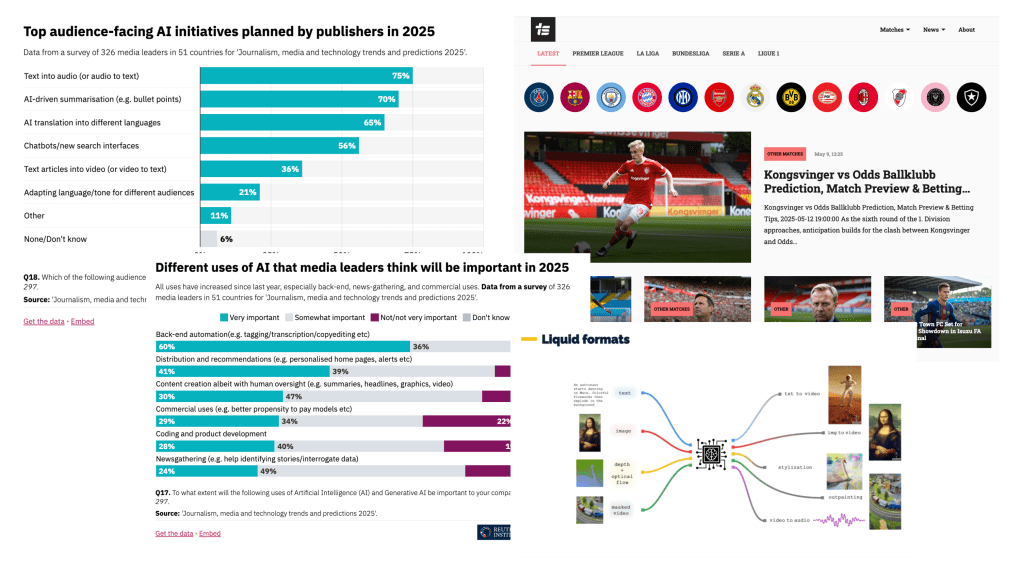
Some editorial processes appear safer to automate — at least within certain content domains. One of the most advanced experiments so far is the Danish company Better Collective’s football transfer news site, run entirely by AI from start to finish. The content is far from perfect of course but it is an interesting experiment.
An ongoing balancing act
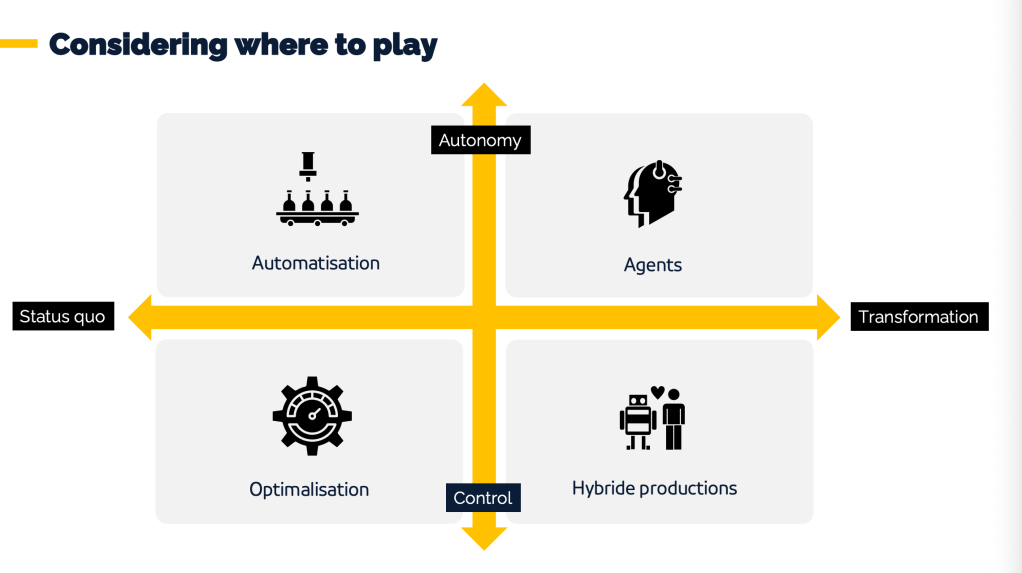
Whether we’re talking about the near future or the long haul, this Ezra Eeman’s strategic quadrant provides a solid framework. It basically illustrates that this is an ongoing balancing act. When the focus shifts toward automation and AI agents, it inevitably comes at the cost if not of actual control, then at least of the feeling of control within an organization.
Eeman’s visual model on the potential of AI agents in media similarly captures the essence of what’s happening, for example, in the aforementioned Danish case:
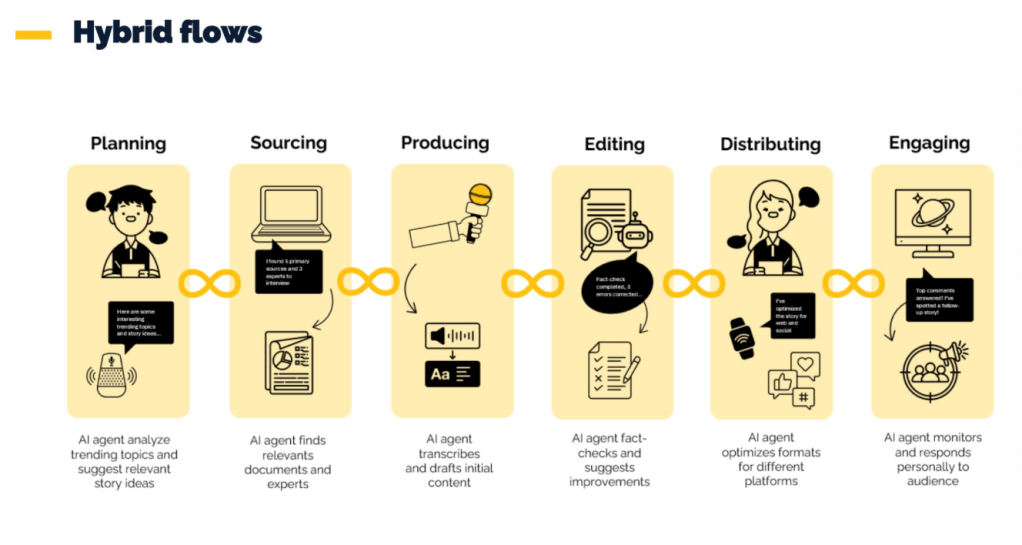
Ezra Eeman is the Director of Strategy and Innovation at the Dutch public broadcaster NPO and an AI advisor for WAN-IFRA, the global association of news publishers.
Short-term: 2025
This part we already know — or at least we have insight into what news organizations are planning for this year, and what kinds of outcomes have been shared at various international seminars.
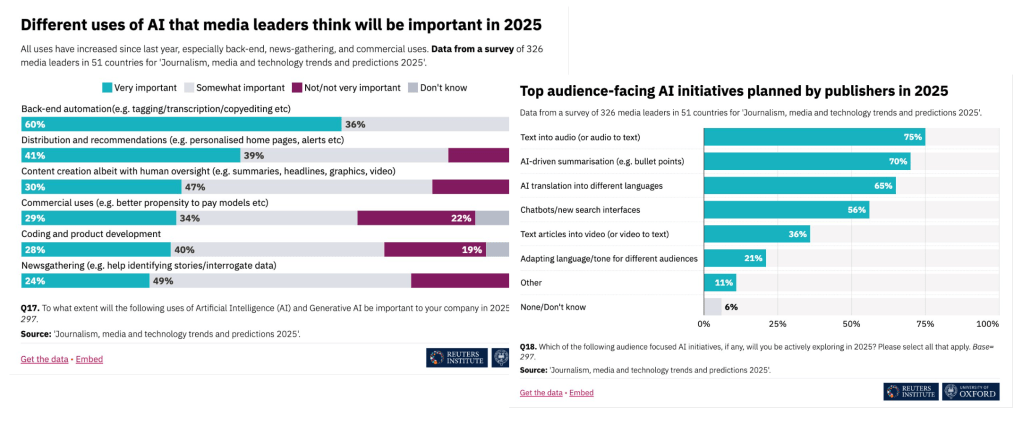
The big picture is outlined in a Reuters Institute survey from January. Two key visuals from the report reveal both what’s happening under the hood and what’s visible to the public.
Many news organizations are either building or have already implemented tools for summarization, translation, content versioning, transcription, SEO, headline generation, audience development, fact-checking, brainstorming, editing, and research. The landscape has diversified dramatically within just one to two years. Initially, AI was mostly used for summarization and translation, but now many of these features have been embedded into newsroom and planning systems where journalists already work every day. Editorial process automation is advancing.
On the audience side, many outlets are experimenting with conversational interfaces. Still, it’s unclear how large an audience truly wants to use such tools specifically for news consumption. This is because these systems require a certain level of activity from the user. And the risks are real: the greatest being if a trustworthy media chatbot ends up delivering false information.
Long-Term: Several years
In media circles, the term liquid content frequently comes up. It was coined by Matthieu Lorrain, creative lead at Google’s DeepMind. Basic AI-assisted content versioning is already a form of this. One example is Süddeutsche Zeitung, where articles can be instantly converted to plain language with the click of a button (this experiment can also be found in my GenAI in media tracker here).
Some foresee a fully hyper-personalized future in which users receive content in the exact format they prefer — automatically — and the traditional ”article” format may even become obsolete. But I wouldn’t bet on this fully yet. The media industry has predicted the death of many formats before (e.g. newspaper reading when radio emerged). Often, old and new end up coexisting. That may well continue to be the case.
Liquid content was one of the recurring themes at the Nordic AI in Media 2025 summit held recently in Denmark. Other themes included:
- Reclaiming time for uniquely human journalism – using the hours saved by AI tools to produce work that can’t be copied or automated.
- Independence from big tech platforms – building in-house tools and integrating them into newsroom workflows. This doesn’t exclude collaboration with major AI providers.
- New business models – a need to move beyond ad- and subscription-only revenue structures.
- Cultural change within newsrooms – requiring openness, curiosity, adaptability, and more transparent collaboration between media organizations — even including competitors.
What truly matters?
Amid all the noise, I myself keep coming back to the same thought: the noise itself – and creativity. How do we identify what’s truly essential in the midst of this chaos? It’s a central journalistic question. I genuinely believe AI will eventually save time in meaningful ways, allowing us to focus on what really matters which means the kind of journalism that is unique and the hardest to replicate. But the shift will be slower than many assume.
As Jukka Niittymaa, one of Finland’s most respected AI experts, put it so eloquently in his recent Linkedin post about knowledge work:
”At first, I thought generative AI would free us from the worst time pressures. I no longer believe that. Our tasks are changing, but it was naive to assume human nature would evolve as fast as the technology.
If we truly want people to generate ideas that AI can’t hallucinate, we must start valuing time for thinking.
But how do we do that in a country where the efficiency of innovation is still often measured in billable hours — even in expert and creative work?”
 Numeroiden takaa