Strategia ja liiketoiminta

Kävijäkato, rahan liikkeet, AI-rintama ja MM-futiskokeilut – tässä kesän 2026 tärkeimmät mediahavainnot // Traffic decline, money on the move, the AI front, and World Cup experiments – the summer’s key media takeaways

Suomeksi – in Finnish (find the English version below or on the side depending on whether you use desktop or mobile):

1. Suuret yrityskaupat

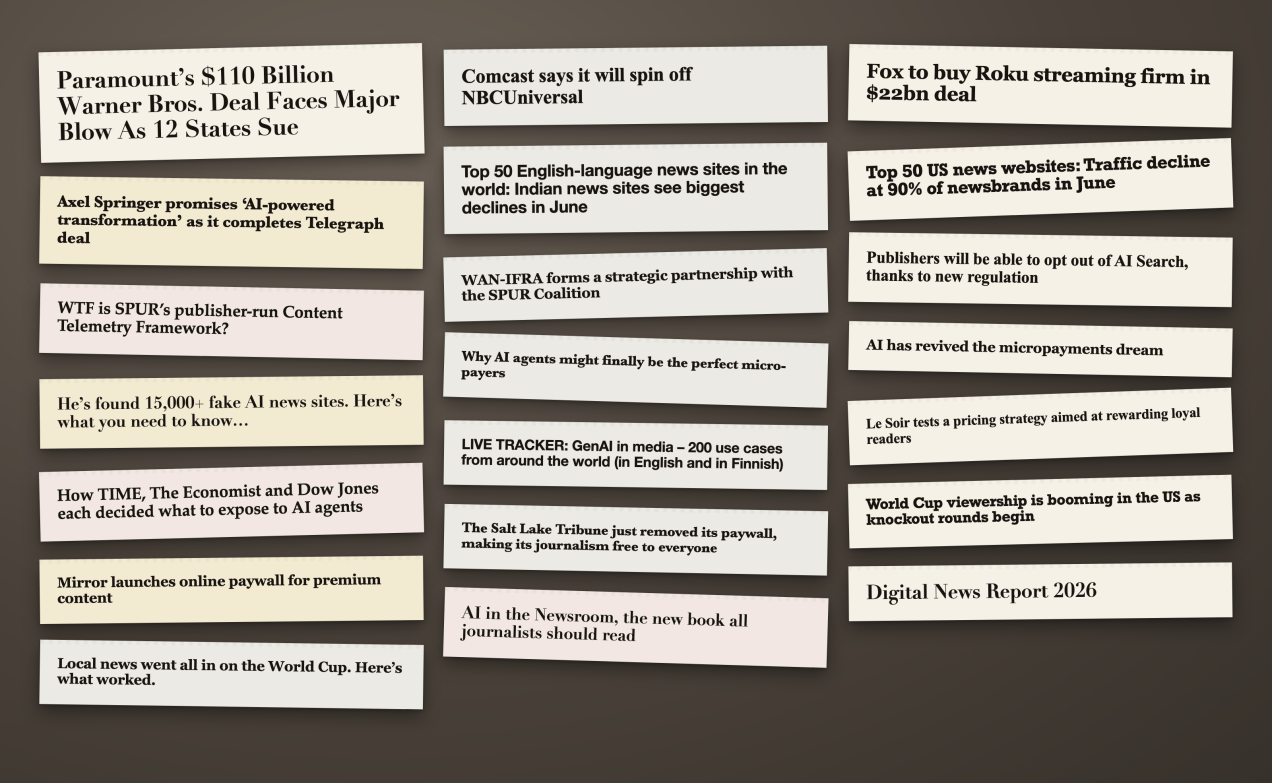
  • Paramount Skydance–WBD: Yhdysvaltain oikeusministeriö hyväksyi Paramountin 110 miljardin dollarin jättikaupan, jossa se ostaa Warner Bros. Discoveryn (HBO, CNN ym.). Useat osavaltiot kuitenkin nostivat oman kanteensa kaupan pysäyttämiseksi kilpailuoikeudellisin perustein, joten sen toteutuminen on yhä epävarmaa. Taustalla on kilpailuoikeudellinen huoli, myös poliittiset jännitteet.
  • Comcast jakautuu kahtia: Yhdysvaltalainen media- ja tietoliikennekonserni Comcast ilmoitti erottavansa NBCUniversalin ja eurooppalaisen mediayksikkönsä Skyn omaksi pörssiyhtiökseen, erilleen laajakaistaliiketoiminnastaan. Uusi sisältöyhtiö (Universal-studiot, teemapuistot, Peacock, NBC, Telemundo, Bravo) olisi houkutteleva kohde varakkaille ostajille. CNN:n mukaan analyytikot pitävät järjestelyä askeleena kohti seuraavaa mediakauppa-aaltoa, vaikka Comcast itse kiistää tämän ja korostaa NBCUniversalin kasvumahdollisuuksia itsenäisenä yhtiönä. Isossa-Britanniassa jakautuminen on herättänyt huolta Sky Newsin tulevaisuudesta.
  • Fox ostaa Rokun 22 miljardilla dollarilla: Suoratoistoalusta Rokun osto käytännössä tuo Foxin sisällöt aiempaa voimakkaammin älytelevisioihin ja vahvistaa sen asemaa suoratoistomarkkinoilla perinteisen tv-kanavabisneksen rinnalla. Kauppa on vielä lopullista hyväksymistä vailla.
  • Axel Springer sai vihdoin Telegraphin: Saksalainen mediakonserni Axel Springer (mm. Bild, Politico) sai kolmen vuoden veivaamisen jälkeen päätökseen kaupan, jossa se osti brittiläisen laatulehden The Telegraphin.

2. Kävijäliikenteen lasku

3. Perinteinen media vs. tekoäly

  • SPUR-koalitio laajenee: Kustantajien perustama yhteenliittymä SPUR rakentaa seurantajärjestelmän, jonka avulla julkaisijat voivat todentaa, millä tavoin tekoälyfirmat käyttävät niiden sisältöä. Tämä toimii pohjana mahdollisille korvausvaatimuksille. Kesän aikana koalitioon liittyivät mm. WAN-IFRA ja uutistoimisto AP, mikä kasvattaa sen painoarvoa.
  • UK:n Google-päätös: Britannian kilpailu- ja markkinaviranomainen määräsi, että Googlen on annettava mediatalojen halutessaan kieltäytyä siitä, että heidän sisältöään käytetään Googlen tekoäly-yhteenvedoissa ilman, että kieltäytyminen “rankaisee” niitä tavallisissa hauissa.
  • 15 000 valesivustoa: Toimittajat ja tutkijat paljastivat laajan verkoston tekoälyn kokonaan generoimia ”uutissivustoja” ja tekaistuja toimittajaprofiileja, jotka tuottavat automatisoitua, usein virheellistä tai keksittyä sisältöä naamioituna aidoksi journalismiksi.
  • Mikromaksut/tekoälyagentit maksajina: OpenAI:n toimitusjohtaja Sam Altman totesi keväällä uskovansa julkaisijoiden tulevaisuuden olevan mikromaksuissa, mutta ihmislukijoiden sijaan tekoälyagenttien maksamina. Useita erilaisia toteutustapoja on kokeiluvaiheessa (mm. Tollbit, Prorata.ai, Cloudflaren pay-per-crawl ja Stripen kesäkuussa julkaisema Machine Payments Protocol), vaikka vakiintunutta mallia ei vielä ole. Aihe nousi kesän media-alan keskusteluun heinäkuussa The Rebootingin ja News Machinesin uutiskirjeissä. Ero nykyisiin kertaluonteisiin lisenssisopimuksiin on se, että kiinteän vuosisumman sijaan julkaisija saisi pienen korvauksen jokaisesta yksittäisestä agenttikäynnistä.
  • TIME, Economist ja Dow Jones tekivät kolme erilaista ratkaisua AI-agenttien pääsystä sisältöön. Kukin päätti eri tavalla, kuinka paljon maksullista sisältöä ne avaavat tekoälypalveluiden haettavaksi ja millä ehdoilla. Osa rajasi pääsyn tiukasti, osa avasi sisältöä laajemmin saadakseen näkyvyyttä tekoälyvastauksissa.
  • Katso myös päivitetty listani tekoälyn käyttötapauksista mediassa täältä. Tsekkaa myös mediastrategi Sergey Yakupovin vastaavantyyppinen listaus.

4. Perinteisen median liiketoimintamallit

5. Jalkapallon MM-kisat, medianäkökulma

  • Fox teki poikkeuksellisen edullisen MM-kisadiilin, analysoidaan media-alan lähteitä kokoavassa CNN:n Reliable Sources -uutiskirjeessä. Katsojaluvut rikkoivat ennätyksiä toistuvasti Yhdysvalloissa läpi koko turnauksen, myös sen jälkeen kun USA putosi kisoista. Fox Sports ilmoitti jo kesäkuun lopussa yli 84 miljoonan amerikkalaisen seuranneen lähetyksiään.
  • Yle sai kritiikkiä tekoälyavusteisesti editoitujen ottelukoosteidensa puutteista: Iltalehden mukaan katsojat huomasivat, että joistain Yle Areenan koosteista jäi pois ratkaisuhetkiä. Yle myönsi tekoälytyökalun olleen uusi ja puutteellinen erityisesti rangaistuspotkukilpailuissa, ja vähensi sen roolia turnauksen loppupuolella.
  • Yhdysvaltalaiset paikallismediat hyödynsivät MM-kisoja kokeillakseen uusia tapoja tavoittaa yleisöä. Esimerkkeinä tarrankeräilytapahtuma Bostonissa ja interaktiiviset kisaoppaat Los Angelesissa. Kisat toivat paikallismedioille runsaasti uusia ja palaavia lukijoita hakemaan käytännön tietoa turnauksesta.

Lähteinä on käytetty seuraavia uutiskirjeitä kesän ajalta: Axios Alerts, CNN Reliable Sources, Press Gazzette, WAN-IFRA, Digiday, Media Copilot, The Rebooting, News Machines. Lisäksi Nieman Lab ja Iltalehti.

Muista myös DNR26. Maailman suurin vertaileva uutistutkimus, Reuters-instituutin Digital News Report 2026 julkaistiin taas kesäkuussa. Kv-raportti löytyy täältä, Suomen-maaraportti täältä ja blogiin tekemäni tiivistelmä täältä.

Kesän kirjasuositus on Aftonbladetin entisen tekoälypomon Martin Schorin ”AI in the Newsroom”, jota on suositeltu laajalti, mm. täällä, täällä ja täällä.

In English (find the Finnish version above or on the side depending on whether you use desktop or mobile):

1. Major Corporate Deals

  • Paramount Skydance–WBD: The US Department of Justice approved Paramount’s $110 billion mega-merger, under which it acquires Warner Bros. Discovery (HBO, CNN, etc.). However, several states filed their own lawsuit to block the deal on antitrust grounds, so its completion remains uncertain. Behind it lies antitrust/competition-law concern, as well as political tensions.
  • Comcast splits in two: US media and telecommunications conglomerate Comcast announced it will spin off NBCUniversal and its European media arm Sky into a separate publicly traded company, apart from its broadband business. The new content company (Universal studios, theme parks, Peacock, NBC, Telemundo, Bravo) would be an attractive target for deep-pocketed buyers. According to CNN, analysts see the move as a step toward the next wave of media dealmaking, even though Comcast itself denies this and emphasizes NBCUniversal’s growth prospects as a standalone company. In the UK, the split has raised concerns about the future of Sky News.
  • Fox buys Roku for $22 billion: The acquisition of streaming platform Roku brings Fox’s content more directly onto smart TVs and strengthens its position in the streaming market alongside its traditional TV channel business. The deal is still pending final approval.
  • Axel Springer finally gets the Telegraph: German media group Axel Springer (Bild, Politico, among others) completed its acquisition of British broadsheet The Telegraph after three years of wrangling.

2. Declining Traffic

3. Traditional Media vs. AI

  • SPUR coalition expands: SPUR is an alliance founded by publishers. It is building a shared ”Content Telemetry Framework” tracking system that lets publishers see and verify how much, and in what ways, AI companies are using their content – providing a basis for potential compensation claims. Over the summer, WAN-IFRA and news agency AP joined the coalition, increasing its clout.
  • UK’s Google ruling: Britain’s competition and markets authority ordered Google to allow media outlets to opt out of having their content used in Google’s AI summaries, without that opt-out ”penalizing” them in regular search results.
  • 15,000 fake sites: Journalists and researchers exposed a vast network of entirely AI-generated ”news sites” and fabricated journalist profiles producing automated, often inaccurate or invented content disguised as genuine journalism.
  • Micropayments/AI agents as payers: OpenAI CEO Sam Altman said in spring 2026 that he believes publishers’ future lies in micropayments but paid not by human readers, rather by AI agents each time they use content. Several different implementations are already in testing (including Tollbit, Prorata.ai, Cloudflare’s pay-per-crawl, and Stripe’s Machine Payments Protocol launched in June), though no single standard model exists yet. The topic entered summer media-industry discussion in July via The Rebooting’s and News Machines’ newsletters. The difference from current one-off licensing deals is that instead of a fixed annual sum, the publisher would receive a small payment for every individual agent visit.
  • TIME, The Economist, and Dow Jones each made a different call on AI agent access to content. Each decided differently how much paid content to expose to AI services like ChatGPT, and on what terms. Some restricted access tightly to protect subscription revenue, while others opened content more broadly to gain visibility in AI-generated answers.
  • See also my updated list of AI use cases in media here. Also check out media strategist Sergey Yakupov’s listing.

4. Traditional Media Business Models

5. The World Cup, a Media Perspective

  • Fox struck an exceptionally cheap World Cup deal, according to analysis compiled in CNN’s media-industry newsletter Reliable Sources. Viewership figures repeatedly broke records in the United States throughout the tournament, even after the US team was eliminated. Fox Sports reported by late June that more than 84 million Americans had watched its coverage.
  • Finnish Broadcasting Company Yle faced criticism over the shortcomings of its AI-edited match highlight reels: according to Finnish tabloid Iltalehti, viewers noticed that some of the highlight clips left out key moments. Yle admitted the AI tool was new and had flaws, particularly around penalty shootouts, and reduced its role toward the end of the tournament.
  • US local media used the World Cup to experiment with new ways of reaching audiencesfor example, a sticker-swap event in Boston and interactive tournament guides in Los Angeles. The tournament brought local outlets a wealth of new and returning readers seeking practical information about the games.

Sources: the following newsletters from over the summer: Axios Alerts, CNN Reliable Sources, Press Gazette, WAN-IFRA, Digiday, Media Copilot, The Rebooting, News Machines. Also Nieman Lab and Iltalehti (Finnish tabloid).

Also worth noting: DNR26. The world’s largest comparative news study, the Reuters Institute’s Digital News Report 2026, was published again in June. The international report can be found here, the Finland country report here, and my own blog summary here (in Finnish).

This summer’s book recommendation is Martin Schori’s ”AI in the Newsroom” – the former head of AI at Aftonbladet — which has been widely recommended, including here, here and here.
Normaali
Strategia ja liiketoiminta, tekoäly

The 5-months AI Builders Lab recap: This is what we did and this is what I learned

By far the best AI course I ever had.

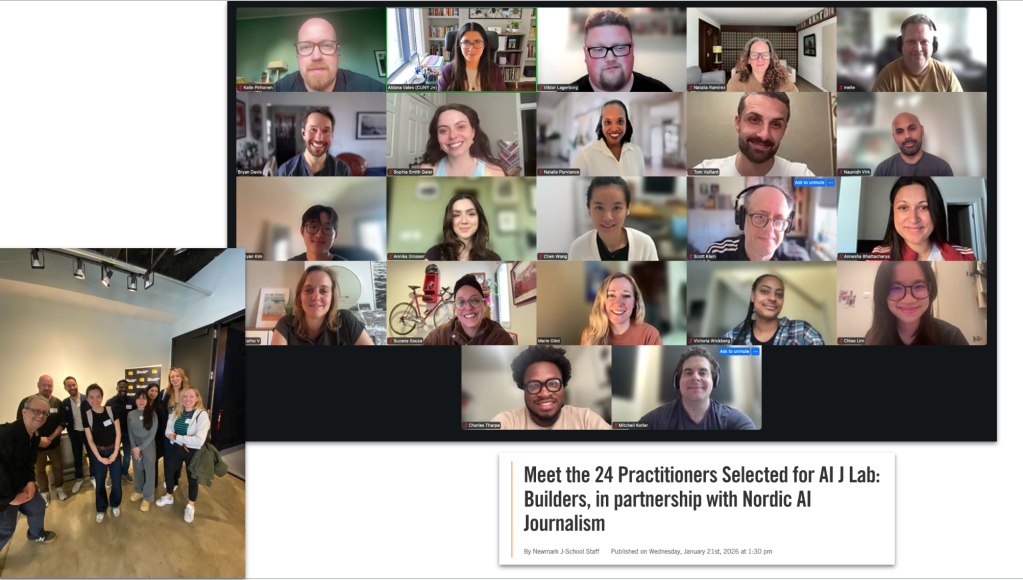
So last week we wrapped up our five months long AI Journalism Lab: Builders at Craig Newmark Graduate School of Journalism at CUNY (City University of New York), in partnership with Nordic AI Journalism.

Shoutout especially to Aldana Vales and Marie Gilot for organizing this so professionally, and of course to the whole amazing cohort of 24 people and our coaches and speakers such as Nikita Roy, Lukas Nielsen, Kasper Lindskow, Joe Amtidis, Upasna Gautam, Elite Truong and others.

The curriculum of the program consisted of these themes:

  • Designing AI products for newsrooms
  • Prototyping with No-Code Tools
  • (Un)Structured data, Semantic Search & RAGs
  • AI Agents & Autonomous Workflows
  • Measurement & Ethics in the Product Lifecycle
  • Launching and Sustaining Products in an AI Future

Each one of us built a final project during these five months, from which you will hear a bit more later on. Mine unfortunately is not public information since I’ve just changed jobs but what I can tell is that it is a python-based tool that has to do with videos, it was built with Google Antigravity, and I’m really happy with how it turned out.

What did I learn?

A whole lot of new stuff, starting from how to actually build a good PRD, product requirement document for AI to use. I will also definitely use several of the newsroom spesific frameworks we came across on the course, like one that helps evaluate and prioritize AI products or features from five different perspectives simultaneously. All in all, I’d say I learned a lot from…

  • How to identify whether a problem is genuinely an AI problem
  • How to prioritize AI development by value and feasibility
  • How to build prototypes fast
  • How the underlying data and AI infrastructure works and where it typically breaks
  • How to evaluate an AI product’s value across multiple dimensions simultaneously
  • How to deal with the fact that building the tools is not usually the hardest part (but scaling)

So why was this the best AI course I ever had?

It was both strategic and concrete. Spesific newsroom context, really hands on. Excitement but not overhype. Realism.

What’s also nice is that our cohort will continue to have discussions in our joint Slack group that will remain after the course as well.

So, if you have the possibility to attend some of CUNY’s offerings, I highly recommend. Check it out here.

Normaali
AI and news media, tekoäly

Googlen tekoälyuudistukset vievät klikkejä uutismedialta – tämä on tilanne Suomessa nyt

Googlen hakukone näyttää käyttäjälleen yhä useammin valmiiksi tiivistettyjä vastauksia. Kehitys kuulostaa ihan kätevältä tiedonhakijalle, mutta uutismedialle se on huolestuttavaa. Moni alan asiantuntija uskoo, että hakukoneliikenne uutismedioihin tulee lähivuosina vähenemään.

Uutismediaan erikoistunut SEO-konsultti Barry Adams kuvailee tulevaa muutosta apokalyptisesti hakukoneliikenteen maailmanlopuksi, ”joka tulee olemaan medialle äärimmäisen kivulias”. Jotain positiivistakin sentään on.

Seuraavassa lyhyesti kahden tuoreimman uudistuksen AI Overviewsin ja AI Moden tiedot ja niiden tilanne Suomessa sekä lisäksi pohdintaa Google Discoverin roolista jatkossa.

Google AI Overviews eli hakutulosten tekoäly-yhteenvedot

Mikä se on?

Googlen AI Overviews on tekoälyn tuottama vastaus, joka ilmestyy hakutulosten yläosaan. Se tiivistää useista lähteistä kerätyn tiedon yhdeksi vastaukseksi.

Miksi tällä on väliä uutismedialle?

Jos tekoäly on käyttäjän mielestä jo tiivistänyt olennaisen, miksi klikata enää uutislinkkiä? Linkkejä kyllä tarjotaan, mutta niitä klikataan vähemmän kuin ennen.

Esimerkiksi brittitabloidi Daily Mailin testissä klikkaukset romahtivat. Daily Mailin SEO-pomo toteaa media-alaa seuraavan Press Gazzetten jutussa, että lehden täytyy keskittyä sisältöön, jota tekoäly ei voi helposti korvata. Tämä tarkoittaa esimerkiksi menestymistä brändihauissa, eli kun joku esimerkiksi etsii tietoa yhdistämällä julkkiksen ja lehden nimen, kuten ”Meghan Markle Daily Mail”. Tällaisissa hauissa ihmiset haluavat juuri kyseisen median version tarinasta.

Daily Mailissa myös pohditaan kolumnien, mielipidekirjoitusten ja liveseurantojen roolin vahvistamista, sillä ne eivät ole tekoäly-yhteenvedoille ideaalia sisältöä.

Tilanne Suomessa

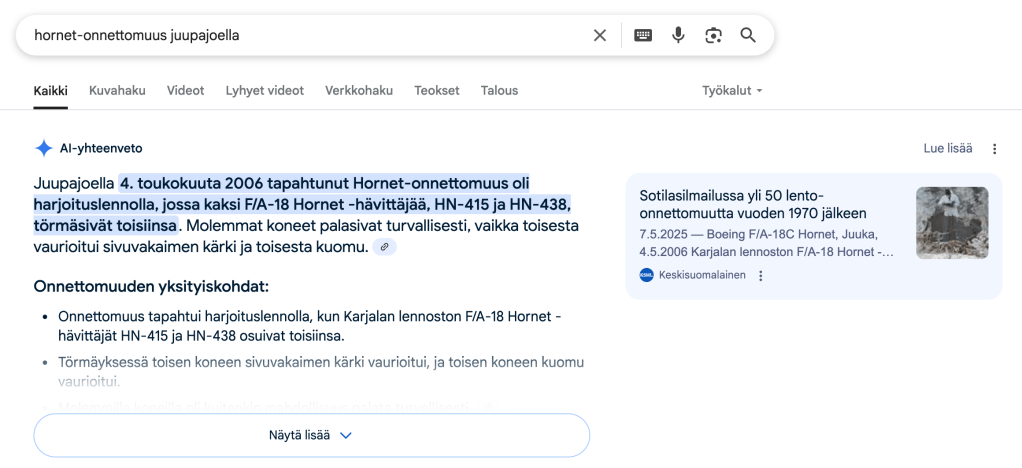
Google otti tekoäly-yhteenvedot käyttöön Suomessa toukokuussa 2025. Et saa niitä välttämättä heti ensimmäisellä yrittämällä näkyviin, sillä ne näkyvät vain osassa hauistasi. Omassa hakuesimerkissäni (alla) yhteenvedon ohessa Google tarjosi linkkiä Keskisuomalaisen juttuun. Yhteenvedot ovat Suomessa niin tuore juttu, että kestää aikansa, ennen kuin niiden vaikutuksista uutisliikenteeseen tiedetään enemmän.

Miltä ne näyttävät?

Google AI Mode eli keskusteleva hakukokemus

Mikä se on?

AI Mode on Googlen uusi hakutila, jossa käyttäjä voi esittää monimutkaisempia kysymyksiä ja saada tekoälyn tuottamia vastauksia, jotka sisältävät syvällisempää analyysiä ja mahdollisuuden jatkokysymyksiin. Toistaiseksi ominaisuus on käytössä vain Yhdysvalloissa.

Miksi tällä on väliä uutismedialle?

AI Mode voi vähentää entisestään tarvetta klikata lähteisiin, sillä se tarjoaa kattavia vastauksia suoraan hakutuloksissa ja on vahvemmin integroitu Googlen palveluihin.

Uutismediaan erikoistunut SEO-konsultti Barry Adams arvioi, että AI Moden vastausten laatu on tekoäly-yhteenvetoja niin paljon parempi, että käyttäjät eivät klikkaa eteenpäin sitäkään vähää. Adamsin Linkedin-postauksessaan näyttämissä esimerkeissä hän on pyytänyt AI Mode -tilassa esimerkiksi tuoreimpia uutisia tai NBA-tuloksia. AI Overviewsin tapaan oikealla näkyy joukko linkkejä medioihin, mutta kieltämättä tekoälyn tarjoama vastaus vaikuttaa sisällöltään runsaammalta ja rakenteeltaan selkeämmältä kuin yhtä pötköä olevat AI Overviews -yhteenvedot. Haut myös jäävät muistiin, jolloin niihin voi palata samaan tapaan kuin ChatGPT:ssä. AI Moden vastaukset tuottaa Googlen tekoälymalli Gemini.

Press Gazetten testissä AI Mode antoi pitkiä vastauksia uutiskyselyihin, ja linkkejä uutismedioiden sivustoille esiintyi hajanaisesti tekstin lomassa. Lisäksi sivupaneelissa näkyi kolme uutissivustoa. Kun haettiin tietoa Press Gazetten omasta uutisesta valeasiantuntijoiden esiintymisestä mediassa, AI Mode linkitti vain sellaisiin julkaisuihin, jotka olivat seuranneet aihetta – ei itse alkuperäiseen lähteeseen.

Tilanne Suomessa

AI Mode on tällä hetkellä saatavilla Yhdysvalloissa. Sen on ennakoitu laajenevan muihin maihin lähitulevaisuudessa, vaikka Google on sanonut kyse olevan ”kokeellisesta” ominaisuudesta.

Miltä se näyttää?

Google Discover on yhä tärkeämpi liikenteenlähde uutismedioille – miten sen käy?

Google Discover ei ole uusi tekoälyominaisuus, vaan jo vuodesta 2018 toiminnassa ollut henkilökohtainen uutisvirta, joka tarjoaa käyttäjälle räätälöityä sisältöä ilman aktiivista hakua. Ominaisuus tuli ensin Android-puhelimien Google- ja Chrome-sovelluksiin ja laajeni myöhemmin iPhoneihin. Google on nyt laajentamassa Discoveria kännyköistä pöytäkonenäkymiin.

Discoverin merkitys liikenteenlähteenä uutismedialle on ollut nousussa myös Suomessa. Liikenteen ennakoiminen on kuitenkin vaikeaa, koska sen algoritmin toiminnasta ei tiedetä kovin paljon.

SEO-konsultti Adams arvioi, että Discoverista tulee tärkein Google-liikenteen lähde valtaosalle uutismediasta, mikä jonkin verran pehmentää uusien tekoälyominaisuuksien tuomaa iskua.

Oma lukunsa on Google News Showcase eli Uutisnostot, jossa Google maksaa myös Suomessa medioille siitä, että ne tarjoavat artikkeleitaan ”Uutisnosto-muodossa”. Uutisnosto-artikkelit voivat näkyä hakutuloksissa, Google Uutiset -uutiskoostimessa (Google News) tai Discoverissa.

Normaali
AI and news media

The road ahead for AI in news media – what’s real, and what really counts?

This is an English translation of my Finnish post from a few days back.

What can we already say about how generative AI is shaping news media in this year, and what might unfold further into the future? The short-term view is clear, the long-term one is more uncertain. The big question in my opinion is how newsrooms can keep their creativity and uniqueness as AI takes a bigger role.

Technology already enables a wide range of capabilities, but not everything should be pursued merely because it’s possible. Trust is at stake. Look what happened to the Italian newspaper Il Foglio. This does not, of course, mean that you should not experiment.

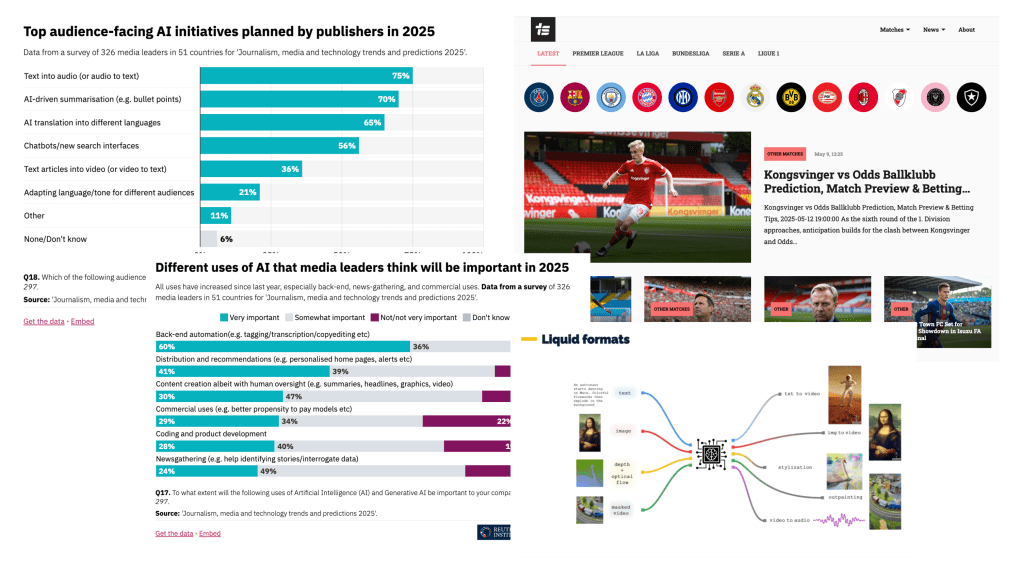
Some editorial processes appear safer to automate — at least within certain content domains. One of the most advanced experiments so far is the Danish company Better Collective’s football transfer news site, run entirely by AI from start to finish. The content is far from perfect of course but it is an interesting experiment.

An ongoing balancing act

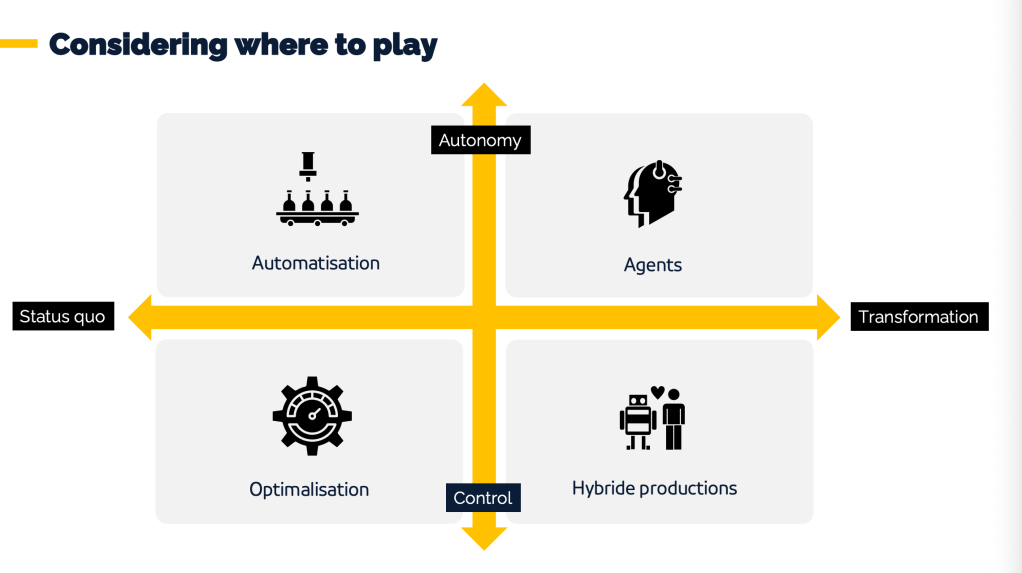
Whether we’re talking about the near future or the long haul, this Ezra Eeman’s strategic quadrant provides a solid framework. It basically illustrates that this is an ongoing balancing act. When the focus shifts toward automation and AI agents, it inevitably comes at the cost if not of actual control, then at least of the feeling of control within an organization.

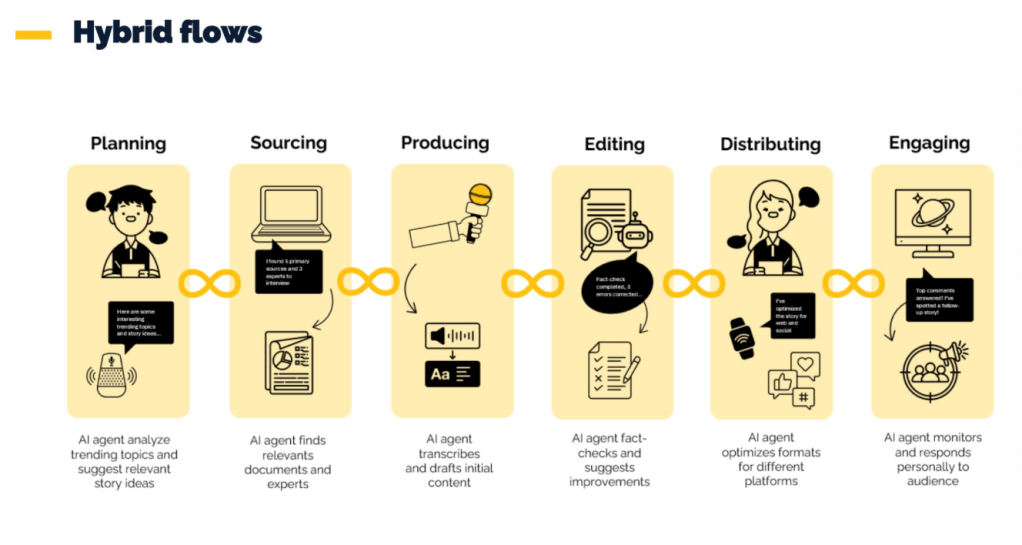
Eeman’s visual model on the potential of AI agents in media similarly captures the essence of what’s happening, for example, in the aforementioned Danish case:

Ezra Eeman is the Director of Strategy and Innovation at the Dutch public broadcaster NPO and an AI advisor for WAN-IFRA, the global association of news publishers.

Short-term: 2025

This part we already know — or at least we have insight into what news organizations are planning for this year, and what kinds of outcomes have been shared at various international seminars.

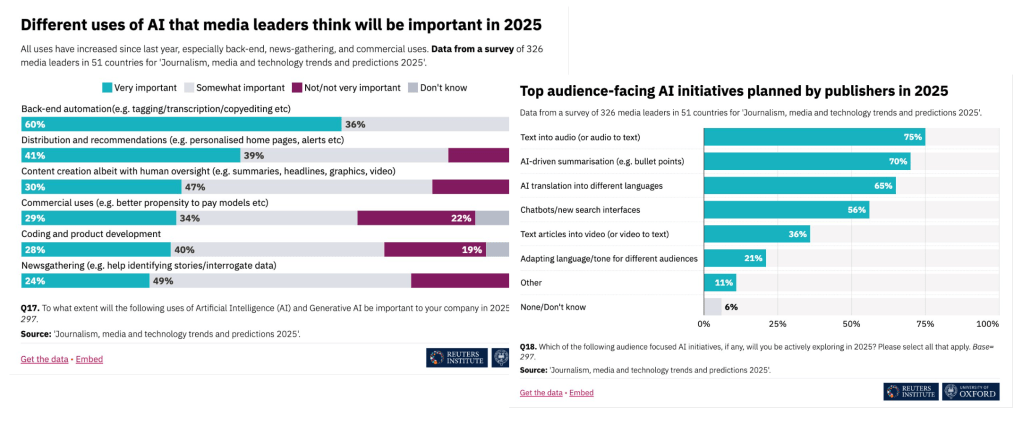
The big picture is outlined in a Reuters Institute survey from January. Two key visuals from the report reveal both what’s happening under the hood and what’s visible to the public.

Many news organizations are either building or have already implemented tools for summarization, translation, content versioning, transcription, SEO, headline generation, audience development, fact-checking, brainstorming, editing, and research. The landscape has diversified dramatically within just one to two years. Initially, AI was mostly used for summarization and translation, but now many of these features have been embedded into newsroom and planning systems where journalists already work every day. Editorial process automation is advancing.

On the audience side, many outlets are experimenting with conversational interfaces. Still, it’s unclear how large an audience truly wants to use such tools specifically for news consumption. This is because these systems require a certain level of activity from the user. And the risks are real: the greatest being if a trustworthy media chatbot ends up delivering false information.

Long-Term: Several years

In media circles, the term liquid content frequently comes up. It was coined by Matthieu Lorrain, creative lead at Google’s DeepMind. Basic AI-assisted content versioning is already a form of this. One example is Süddeutsche Zeitung, where articles can be instantly converted to plain language with the click of a button (this experiment can also be found in my GenAI in media tracker here).

Some foresee a fully hyper-personalized future in which users receive content in the exact format they prefer — automatically — and the traditional ”article” format may even become obsolete. But I wouldn’t bet on this fully yet. The media industry has predicted the death of many formats before (e.g. newspaper reading when radio emerged). Often, old and new end up coexisting. That may well continue to be the case.

Liquid content was one of the recurring themes at the Nordic AI in Media 2025 summit held recently in Denmark. Other themes included:

  • Reclaiming time for uniquely human journalism – using the hours saved by AI tools to produce work that can’t be copied or automated.
  • Independence from big tech platforms – building in-house tools and integrating them into newsroom workflows. This doesn’t exclude collaboration with major AI providers.
  • New business models – a need to move beyond ad- and subscription-only revenue structures.
  • Cultural change within newsrooms – requiring openness, curiosity, adaptability, and more transparent collaboration between media organizations — even including competitors.

What truly matters?

Amid all the noise, I myself keep coming back to the same thought: the noise itself – and creativity. How do we identify what’s truly essential in the midst of this chaos? It’s a central journalistic question. I genuinely believe AI will eventually save time in meaningful ways, allowing us to focus on what really matters which means the kind of journalism that is unique and the hardest to replicate. But the shift will be slower than many assume.

As Jukka Niittymaa, one of Finland’s most respected AI experts, put it so eloquently in his recent Linkedin post about knowledge work:

”At first, I thought generative AI would free us from the worst time pressures. I no longer believe that. Our tasks are changing, but it was naive to assume human nature would evolve as fast as the technology.
If we truly want people to generate ideas that AI can’t hallucinate, we must start valuing time for thinking.
But how do we do that in a country where the efficiency of innovation is still often measured in billable hours — even in expert and creative work?”

Normaali
Strategia ja liiketoiminta

LIVE TRACKER: GenAI in media – 200 use cases from around the world (in English and in Finnish)

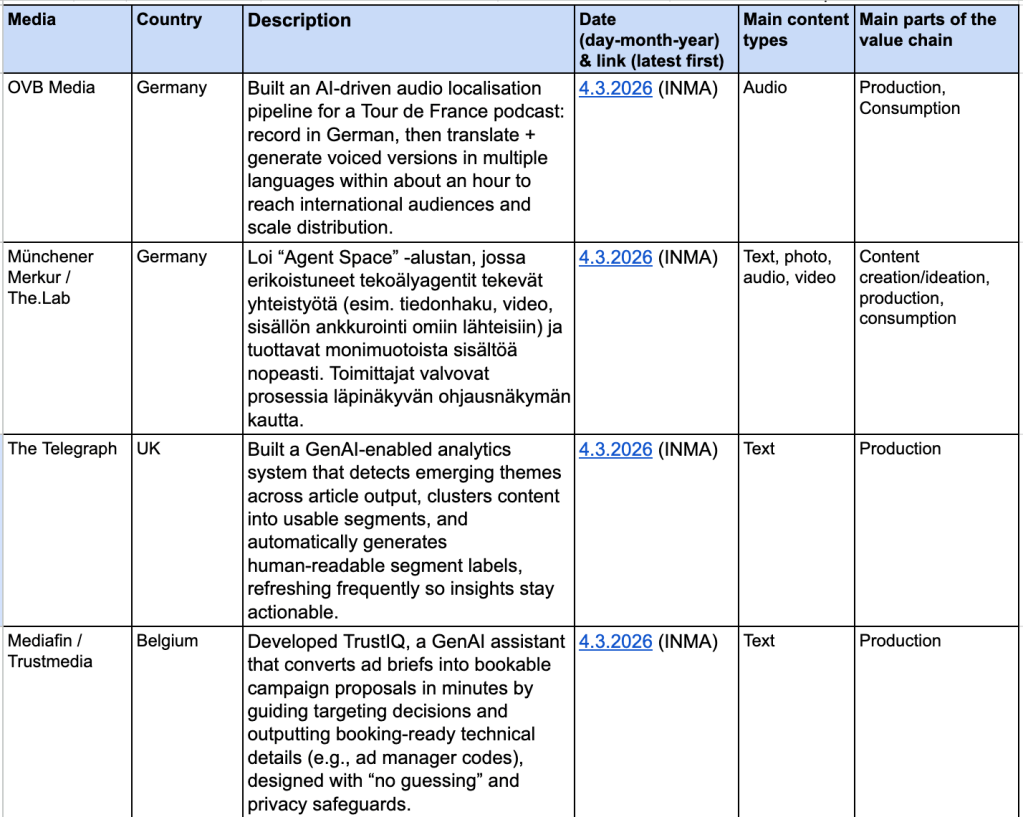
A screenshot of the list. A scrollable list can be found below, both in English and in Finnish.

The List in English – scrollable horizontally and vertically & with clickable links (works best on computer, not by phone):

The List in Finnish – Finnish examples are highlighted green:

***

What is this list and who am I?

When first published in early 2025, I was asked to do this list in English as well and not just in Finnish, so here you go: in this blog you can find an updating list of GenAI tools and products in media, both in English and in Finnish. My name is Kalle Pirhonen, and as of late May 2026 I’m starting as an Executive Producer, Editorial AI Development at Alma Media, Finland (previously AI producer at Ilta-Sanomat, a Finnish tabloid owned by Sanoma Media Finland).

I am updating this list using several publicly available sources such as press releases from media companies, media industry events, publications, and newsletters, LinkedIn (e.g. Ezra Eeman’s Wayfinder and Martin Schori’s Aftonbladet’s AI Hub Buzz), Nordic AI Journalism network, Wan-Ifra, INMA, Reuters Institute, Thomson Reuters Foundation, JournalismAI website (Case studies), Newsroom Robots podcast etc. In the list I’ve also included media industry value chain placement for the examples and also, whether the example is mostly about text, audio or video. Please note that the dates are clickable links to the source.

I will update the list continuously in this blog post. My apologies if you detect some mistakes – if you notice any or want to tip me about some new great examples or sources for updating this list, please contact me via Linkedin here!

The name of this blog, ”Numeroiden takaa”, means ”Behind numbers” and it deals with the media industry’s operating environment. I’ve written the blog mainly in Finnish since 2017.

Normaali