AI and news media, tekoäly

Googlen tekoälyuudistukset vievät klikkejä uutismedialta – tämä on tilanne Suomessa nyt

Googlen hakukone näyttää käyttäjälleen yhä useammin valmiiksi tiivistettyjä vastauksia. Kehitys kuulostaa ihan kätevältä tiedonhakijalle, mutta uutismedialle se on huolestuttavaa. Moni alan asiantuntija uskoo, että hakukoneliikenne uutismedioihin tulee lähivuosina vähenemään.

Uutismediaan erikoistunut SEO-konsultti Barry Adams kuvailee tulevaa muutosta apokalyptisesti hakukoneliikenteen maailmanlopuksi, ”joka tulee olemaan medialle äärimmäisen kivulias”. Jotain positiivistakin sentään on.

Seuraavassa lyhyesti kahden tuoreimman uudistuksen AI Overviewsin ja AI Moden tiedot ja niiden tilanne Suomessa sekä lisäksi pohdintaa Google Discoverin roolista jatkossa.

Google AI Overviews eli hakutulosten tekoäly-yhteenvedot

Mikä se on?

Googlen AI Overviews on tekoälyn tuottama vastaus, joka ilmestyy hakutulosten yläosaan. Se tiivistää useista lähteistä kerätyn tiedon yhdeksi vastaukseksi.

Miksi tällä on väliä uutismedialle?

Jos tekoäly on käyttäjän mielestä jo tiivistänyt olennaisen, miksi klikata enää uutislinkkiä? Linkkejä kyllä tarjotaan, mutta niitä klikataan vähemmän kuin ennen.

Esimerkiksi brittitabloidi Daily Mailin testissä klikkaukset romahtivat. Daily Mailin SEO-pomo toteaa media-alaa seuraavan Press Gazzetten jutussa, että lehden täytyy keskittyä sisältöön, jota tekoäly ei voi helposti korvata. Tämä tarkoittaa esimerkiksi menestymistä brändihauissa, eli kun joku esimerkiksi etsii tietoa yhdistämällä julkkiksen ja lehden nimen, kuten ”Meghan Markle Daily Mail”. Tällaisissa hauissa ihmiset haluavat juuri kyseisen median version tarinasta.

Daily Mailissa myös pohditaan kolumnien, mielipidekirjoitusten ja liveseurantojen roolin vahvistamista, sillä ne eivät ole tekoäly-yhteenvedoille ideaalia sisältöä.

Tilanne Suomessa

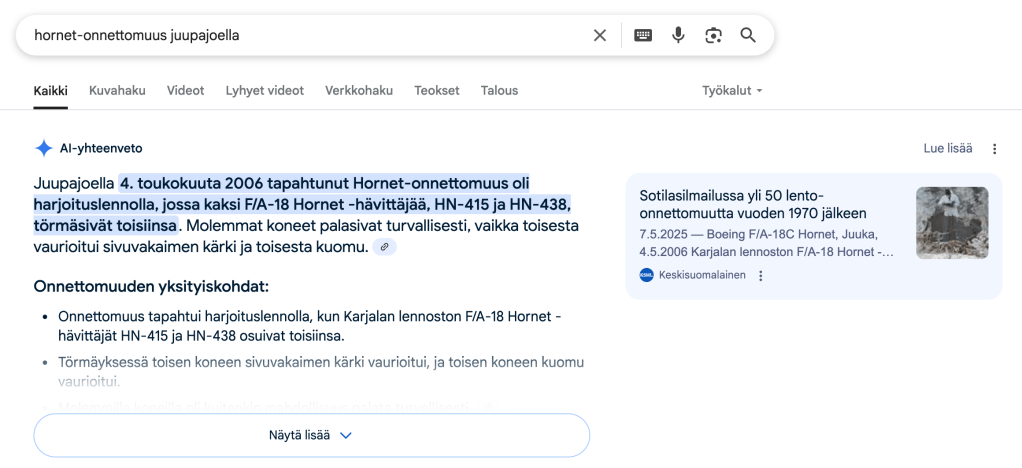
Google otti tekoäly-yhteenvedot käyttöön Suomessa toukokuussa 2025. Et saa niitä välttämättä heti ensimmäisellä yrittämällä näkyviin, sillä ne näkyvät vain osassa hauistasi. Omassa hakuesimerkissäni (alla) yhteenvedon ohessa Google tarjosi linkkiä Keskisuomalaisen juttuun. Yhteenvedot ovat Suomessa niin tuore juttu, että kestää aikansa, ennen kuin niiden vaikutuksista uutisliikenteeseen tiedetään enemmän.

Miltä ne näyttävät?
Google AI Mode eli keskusteleva hakukokemus

Mikä se on?

AI Mode on Googlen uusi hakutila, jossa käyttäjä voi esittää monimutkaisempia kysymyksiä ja saada tekoälyn tuottamia vastauksia, jotka sisältävät syvällisempää analyysiä ja mahdollisuuden jatkokysymyksiin. Toistaiseksi ominaisuus on käytössä vain Yhdysvalloissa.

Miksi tällä on väliä uutismedialle?

AI Mode voi vähentää entisestään tarvetta klikata lähteisiin, sillä se tarjoaa kattavia vastauksia suoraan hakutuloksissa ja on vahvemmin integroitu Googlen palveluihin.

Uutismediaan erikoistunut SEO-konsultti Barry Adams arvioi, että AI Moden vastausten laatu on tekoäly-yhteenvetoja niin paljon parempi, että käyttäjät eivät klikkaa eteenpäin sitäkään vähää. Adamsin Linkedin-postauksessaan näyttämissä esimerkeissä hän on pyytänyt AI Mode -tilassa esimerkiksi tuoreimpia uutisia tai NBA-tuloksia. AI Overviewsin tapaan oikealla näkyy joukko linkkejä medioihin, mutta kieltämättä tekoälyn tarjoama vastaus vaikuttaa sisällöltään runsaammalta ja rakenteeltaan selkeämmältä kuin yhtä pötköä olevat AI Overviews -yhteenvedot. Haut myös jäävät muistiin, jolloin niihin voi palata samaan tapaan kuin ChatGPT:ssä. AI Moden vastaukset tuottaa Googlen tekoälymalli Gemini.

Press Gazetten testissä AI Mode antoi pitkiä vastauksia uutiskyselyihin, ja linkkejä uutismedioiden sivustoille esiintyi hajanaisesti tekstin lomassa. Lisäksi sivupaneelissa näkyi kolme uutissivustoa. Kun haettiin tietoa Press Gazetten omasta uutisesta valeasiantuntijoiden esiintymisestä mediassa, AI Mode linkitti vain sellaisiin julkaisuihin, jotka olivat seuranneet aihetta – ei itse alkuperäiseen lähteeseen.

Tilanne Suomessa

AI Mode on tällä hetkellä saatavilla Yhdysvalloissa. Sen on ennakoitu laajenevan muihin maihin lähitulevaisuudessa, vaikka Google on sanonut kyse olevan ”kokeellisesta” ominaisuudesta.

Miltä se näyttää?

Google Discover on yhä tärkeämpi liikenteenlähde uutismedioille – miten sen käy?

Google Discover ei ole uusi tekoälyominaisuus, vaan jo vuodesta 2018 toiminnassa ollut henkilökohtainen uutisvirta, joka tarjoaa käyttäjälle räätälöityä sisältöä ilman aktiivista hakua. Ominaisuus tuli ensin Android-puhelimien Google- ja Chrome-sovelluksiin ja laajeni myöhemmin iPhoneihin. Google on nyt laajentamassa Discoveria kännyköistä pöytäkonenäkymiin.

Discoverin merkitys liikenteenlähteenä uutismedialle on ollut nousussa myös Suomessa. Liikenteen ennakoiminen on kuitenkin vaikeaa, koska sen algoritmin toiminnasta ei tiedetä kovin paljon.

SEO-konsultti Adams arvioi, että Discoverista tulee tärkein Google-liikenteen lähde valtaosalle uutismediasta, mikä jonkin verran pehmentää uusien tekoälyominaisuuksien tuomaa iskua.

Oma lukunsa on Google News Showcase eli Uutisnostot, jossa Google maksaa myös Suomessa medioille siitä, että ne tarjoavat artikkeleitaan ”Uutisnosto-muodossa”. Uutisnosto-artikkelit voivat näkyä hakutuloksissa, Google Uutiset -uutiskoostimessa (Google News) tai Discoverissa.
Normaali
AI and news media

The road ahead for AI in news media – what’s real, and what really counts?

This is an English translation of my Finnish post from a few days back.

What can we already say about how generative AI is shaping news media in this year, and what might unfold further into the future? The short-term view is clear, the long-term one is more uncertain. The big question in my opinion is how newsrooms can keep their creativity and uniqueness as AI takes a bigger role.

Technology already enables a wide range of capabilities, but not everything should be pursued merely because it’s possible. Trust is at stake. Look what happened to the Italian newspaper Il Foglio. This does not, of course, mean that you should not experiment.

Some editorial processes appear safer to automate — at least within certain content domains. One of the most advanced experiments so far is the Danish company Better Collective’s football transfer news site, run entirely by AI from start to finish. The content is far from perfect of course but it is an interesting experiment.

An ongoing balancing act

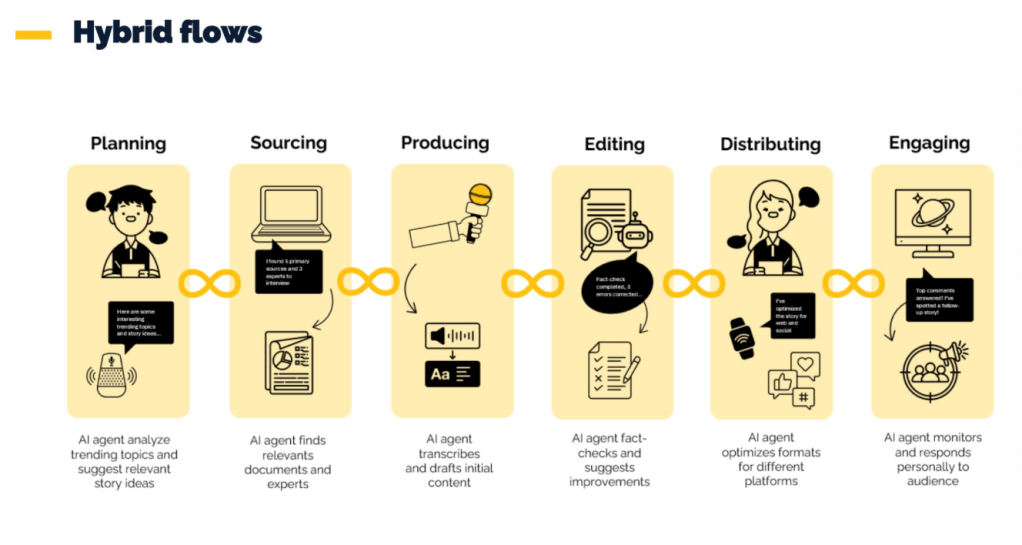
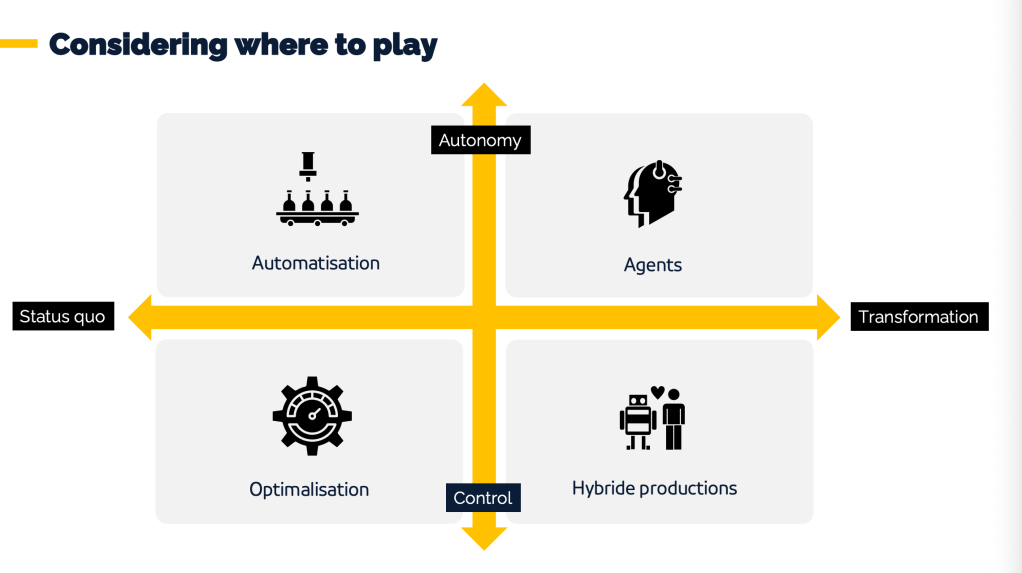
Whether we’re talking about the near future or the long haul, this Ezra Eeman’s strategic quadrant provides a solid framework. It basically illustrates that this is an ongoing balancing act. When the focus shifts toward automation and AI agents, it inevitably comes at the cost if not of actual control, then at least of the feeling of control within an organization.

Eeman’s visual model on the potential of AI agents in media similarly captures the essence of what’s happening, for example, in the aforementioned Danish case:

Ezra Eeman is the Director of Strategy and Innovation at the Dutch public broadcaster NPO and an AI advisor for WAN-IFRA, the global association of news publishers.

Short-term: 2025

This part we already know — or at least we have insight into what news organizations are planning for this year, and what kinds of outcomes have been shared at various international seminars.

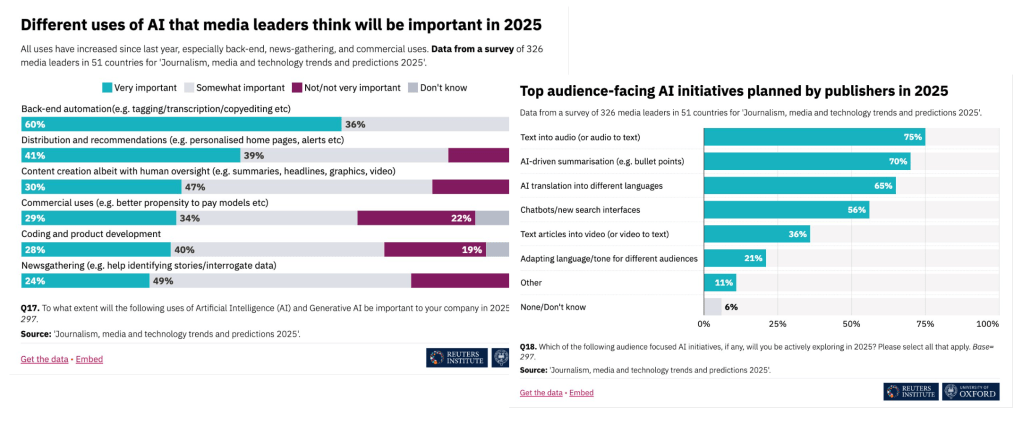
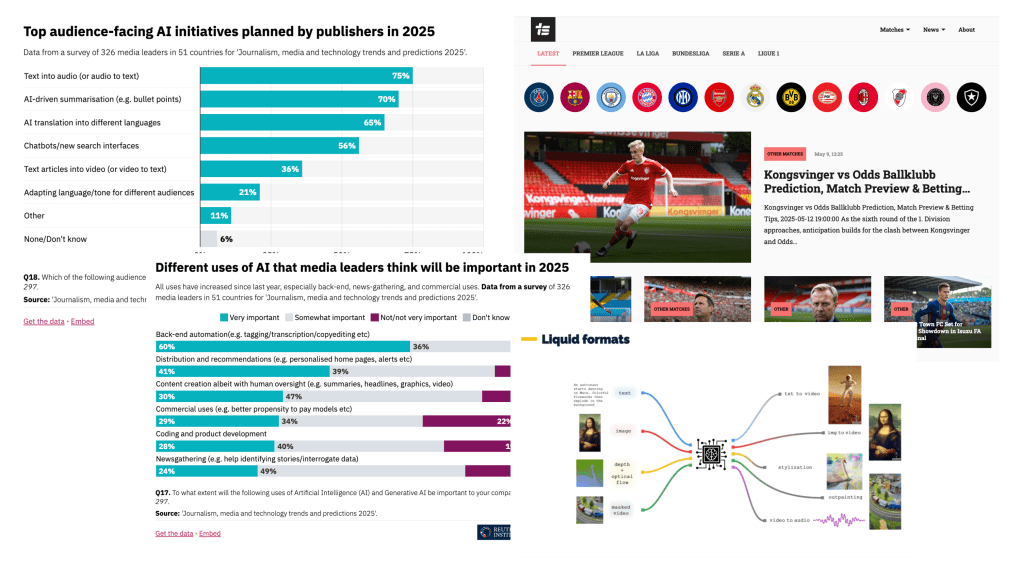
The big picture is outlined in a Reuters Institute survey from January. Two key visuals from the report reveal both what’s happening under the hood and what’s visible to the public.

Many news organizations are either building or have already implemented tools for summarization, translation, content versioning, transcription, SEO, headline generation, audience development, fact-checking, brainstorming, editing, and research. The landscape has diversified dramatically within just one to two years. Initially, AI was mostly used for summarization and translation, but now many of these features have been embedded into newsroom and planning systems where journalists already work every day. Editorial process automation is advancing.

On the audience side, many outlets are experimenting with conversational interfaces. Still, it’s unclear how large an audience truly wants to use such tools specifically for news consumption. This is because these systems require a certain level of activity from the user. And the risks are real: the greatest being if a trustworthy media chatbot ends up delivering false information.

Long-Term: Several years

In media circles, the term liquid content frequently comes up. It was coined by Matthieu Lorrain, creative lead at Google’s DeepMind. Basic AI-assisted content versioning is already a form of this. One example is Süddeutsche Zeitung, where articles can be instantly converted to plain language with the click of a button (this experiment can also be found in my GenAI in media tracker here).

Some foresee a fully hyper-personalized future in which users receive content in the exact format they prefer — automatically — and the traditional ”article” format may even become obsolete. But I wouldn’t bet on this fully yet. The media industry has predicted the death of many formats before (e.g. newspaper reading when radio emerged). Often, old and new end up coexisting. That may well continue to be the case.

Liquid content was one of the recurring themes at the Nordic AI in Media 2025 summit held recently in Denmark. Other themes included:

  • Reclaiming time for uniquely human journalism – using the hours saved by AI tools to produce work that can’t be copied or automated.
  • Independence from big tech platforms – building in-house tools and integrating them into newsroom workflows. This doesn’t exclude collaboration with major AI providers.
  • New business models – a need to move beyond ad- and subscription-only revenue structures.
  • Cultural change within newsrooms – requiring openness, curiosity, adaptability, and more transparent collaboration between media organizations — even including competitors.

What truly matters?

Amid all the noise, I myself keep coming back to the same thought: the noise itself – and creativity. How do we identify what’s truly essential in the midst of this chaos? It’s a central journalistic question. I genuinely believe AI will eventually save time in meaningful ways, allowing us to focus on what really matters which means the kind of journalism that is unique and the hardest to replicate. But the shift will be slower than many assume.

As Jukka Niittymaa, one of Finland’s most respected AI experts, put it so eloquently in his recent Linkedin post about knowledge work:

”At first, I thought generative AI would free us from the worst time pressures. I no longer believe that. Our tasks are changing, but it was naive to assume human nature would evolve as fast as the technology.
If we truly want people to generate ideas that AI can’t hallucinate, we must start valuing time for thinking.
But how do we do that in a country where the efficiency of innovation is still often measured in billable hours — even in expert and creative work?”

Normaali
Strategia ja liiketoiminta

LIVE TRACKER: GenAI in media – 130+ tools and products from around the world (in English and in Finnish)

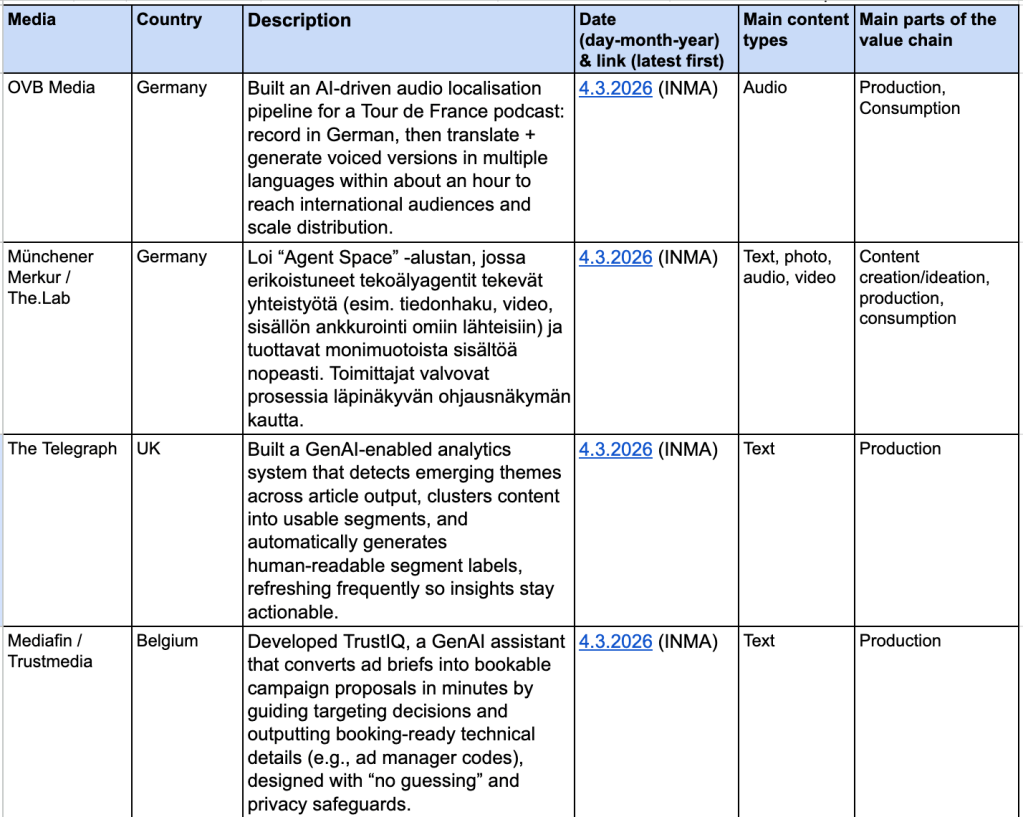
A screenshot of the list and some of the sources. A scrollable list can be found at the end of this blog.

I was asked to do this list in English as well and not just in Finnish, so here you go: in this blog you can now find an updating list of GenAI tools and products in media, both in English and in Finnish. My name is Kalle Pirhonen, and I work as an AI producer in Ilta-Sanomat, a Finnish tabloid owned by Sanoma Media Finland. I guess you could call me a media analyst as well because this blog is just a hobby of mine and media analysis was a part of my previous job at the Finnish Broadcasting Company.

I am updating this list using several publicly available sources such as press releases from media companies, media industry events, publications, and newsletters, LinkedIn (e.g. Ezra Eeman’s Wayfinder and Martin Schori’s Aftonbladet’s AI Hub Buzz), Nordic AI Journalism network, Wan-Ifra, INMA, Reuters Institute, Thomson Reuters Foundation, JournalismAI website (Case studies), Newsroom Robots podcast etc. In the list I’ve also included media industry value chain placement for the examples and also, whether the example is mostly about text, audio or video. Please note that the dates are clickable links to the source.

I will update the list continuously in this blog. My motive for making this list is to simply put all the interesting examples in one place because they are scattered over the internet. My apologies if you detect some mistakes – if you notice any or want to tip me about some new great examples or sources for updating this list, please contact me via Linkedin here!

The List in English – scrollable horizontally and vertically & with clickable links (works best on computer, not by phone):

The List in Finnish – Finnish examples are highlighted green:

***

The name of this blog, ”Numeroiden takaa”, means ”Behind numbers” and it deals with the media industry’s operating environment. I’ve written the blog mainly in Finnish since 2017.

Normaali